
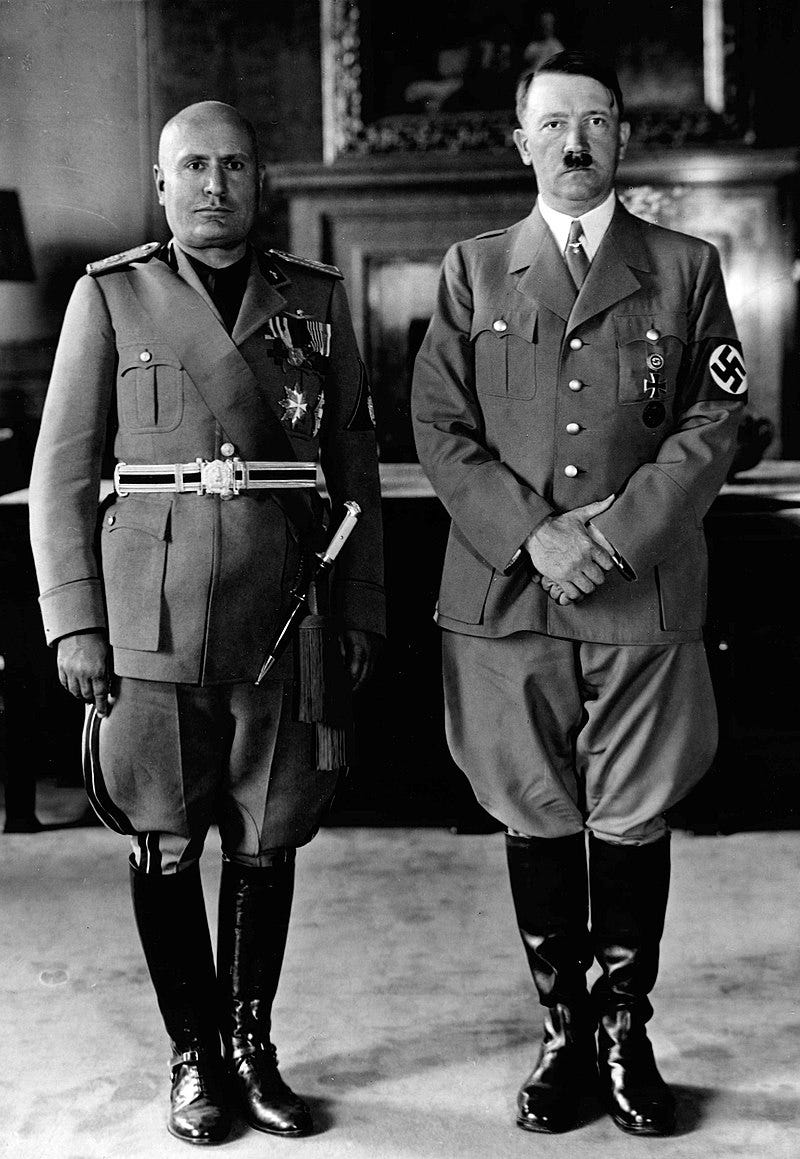
The communist and fascist ideologies of twentieth-century totalitarian regimes were not merely opposites; they also reflected a shared belief: that the self-government of free individuals must yield to absolute authority in service of collective ends defined by the regime, reducing the individual to an instrument of its power. Today, patterns associated with these doctrines are visible in Russia’s highly centralized authoritarian rule under Vladimir Putin, the cult of personality centered on Xi Jinping, and North Korea’s dynastic leadership cult under Kim Jong Un. Recognizing these patterns is not merely an academic exercise but a civic necessity. The lesson of the last century is that totalitarianism begins not with armaments and decrees, but with the quiet surrender of the mind.
To understand how this mindset took hold, we must look not at its end, but at its origins.
History
“More than a half a century ago, I was privileged to take the last course Hans J. Morgenthau taught at the University of Chicago. Among the many wise things he said that have remained with me in the years since was his relating of an anecdote about the difference between democracy, authoritarianism and totalitarianism.
Morgenthau said that there were of course many differences but he insisted that the key one was this: in a democratic political system, everything not prohibited is permitted; in an authoritarian regime, everything that [is] not permitted is prohibited; and in a totalitarian one, everything permitted is compulsory.”—Paul A. Goble, recalling Hans J. Morgenthau, “Putin’s Russia Moving toward One Definition of Totalitarianism Where Everything Permitted Is Compulsory, Grashchenkov Suggests,” Window on Eurasia, October 20, 2024.
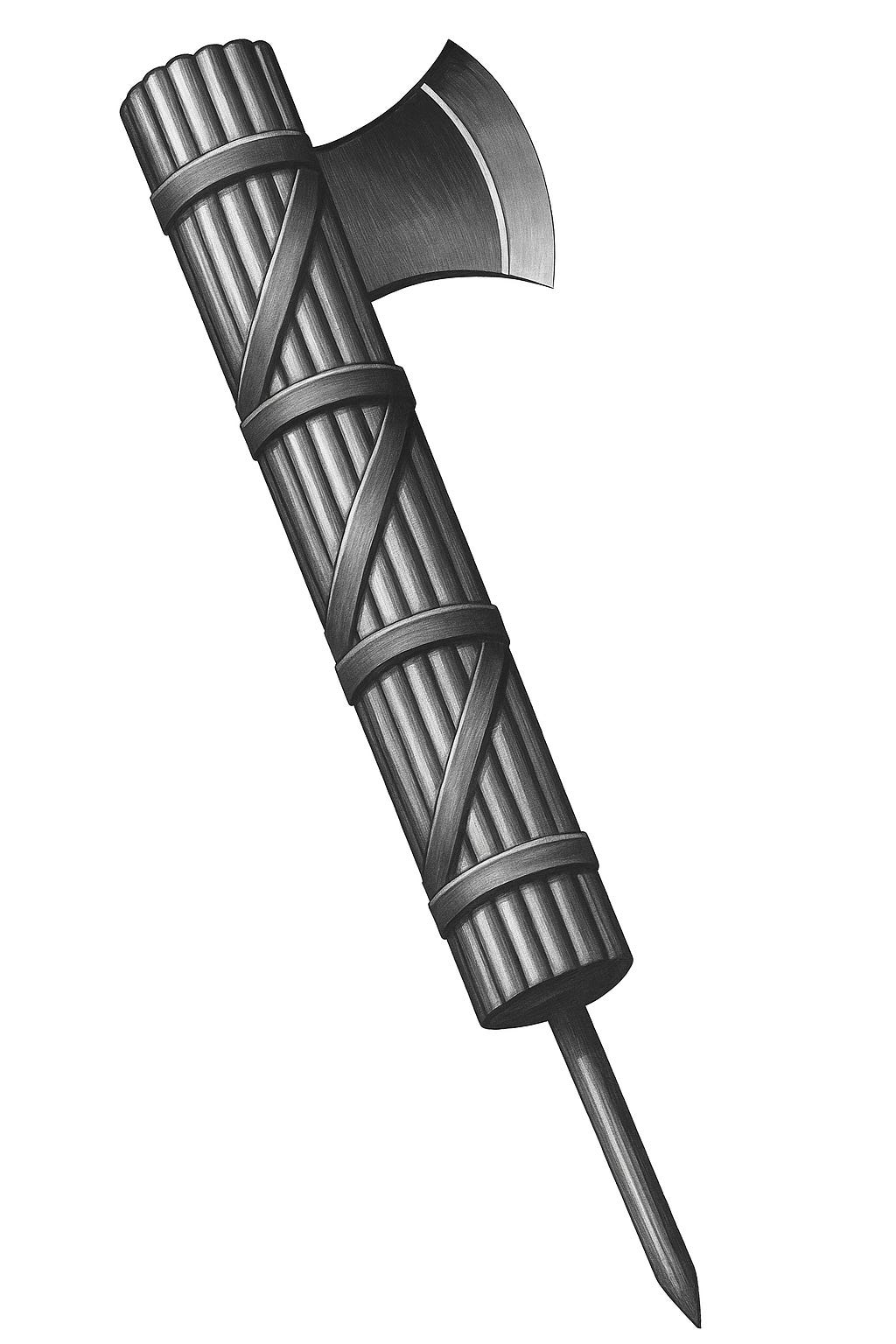
The word fascism derives from the Italian fascismo, itself derived from fascio, meaning a bundle or political association. The movement adopted the ancient Roman fasces—a bundle of rods, sometimes surrounding an ax—as a symbol of magisterial authority and strength through unity.
In the decades following Italian unification, militant nationalists increasingly conceived of national unity as both an instrument of state power and a means of overcoming class divisions. Mussolini would later express the fascist version of this ideal in a formula he proclaimed in 1925: “Everything within the State, nothing outside the State, nothing against the State.”
Elements later associated with fascism—a unifying national myth, a leader claiming the exclusive right to define truth and national destiny, the glorification of struggle, the belief in violence as transformative, and a public increasingly indifferent to objective reality—did not appear out of nowhere. Several of these elements developed within the intellectual ferment of the revolutionary left, especially revolutionary syndicalism, while others arose from militant nationalism, anti-liberalism, imperialism, and theories of hierarchy and elite rule.
Mussolini acknowledged his ideological debt to revolutionary syndicalism and, above all, to Georges Sorel:
“I owe most to Georges Sorel. This master of syndicalism by his rough theories of revolutionary tactics has contributed most to form the discipline, energy and power of the fascist cohorts.”
—Benito Mussolini, quoted in Arthur Versluis, The New Inquisitions: Heretic-Hunting and the Intellectual Origins of Modern Totalitarianism (Oxford University Press, 2006), 39.
- Before 1914, Benito Mussolini was a leading figure in the Italian Socialist Party and editor of its official newspaper, Avanti!.
- In 1914, Mussolini resigned as editor of Avanti! amid controversy over his support for Italian intervention in World War I. After founding the interventionist newspaper Il Popolo d’Italia, he was expelled from the Italian Socialist Party.
The influence of these currents is evident in Mussolini’s writing in Il Popolo d’Italia from 1914 to 1919, where he increasingly subordinated class struggle to a national identity forged through war. This can be understood as a revisionist redirection of elements inherited from Marxism: from class to nation, from the proletariat to the patria.
- In March 1919, Mussolini founded the Fasci Italiani di Combattimento; at its third national congress in November 1921, the movement established the National Fascist Party.
- In 1922, Mussolini was appointed prime minister and, beginning in 1925, dismantled Italy’s remaining democratic institutions and established an overt fascist dictatorship, which lasted until his removal in July 1943.
- In 1932, the Enciclopedia Italiana published “The Doctrine of Fascism” under Mussolini’s name as part of its entry on fascism. Its philosophical section is generally attributed to Giovanni Gentile, while its political and social section is more directly associated with Mussolini.
- In 1938, Hitler credited Mussolini with reviving the Italian state:
“Now today after nearly two thousand years, thanks to your historic activity, Benito Mussolini, the Roman State arises from remote traditions to new life.”
—Adolf Hitler, speech in Rome, May 7, 1938, reproduced in My New Order: Hitler’s Speeches, edited by Raoul de Roussy de Sales (Reynal & Hitchcock, 1941).
- From 1943 to 1945, Mussolini headed the German-dependent Italian Social Republic in German-occupied northern Italy.
In this progression—from revolutionary socialist to nationalist revolutionary—we can see one route by which elements of Marxist collectivism and revolutionary syndicalism were redirected into fascist totalitarianism.
Why This Matters
But fascism’s defeat in 1945 did not abolish its promises of unity through submission and salvation through violence. They survived, awaiting new myths and new messiahs to revive them.
The mentality of fascism, including the revolutionary collectivist impulses it partly inherited from revolutionary socialism and syndicalism, remains evident among those who excuse or admire authoritarian behavior in democratic societies, whether cloaked in nationalism or other ideologies. If we believe that fascism cannot emerge without our explicit awareness—or, more insidiously, that we are necessarily free so long as we do not live under communism—then we are sadly mistaken. But resistance does not begin on the battlefield. We must never succumb to the illusion that dictatorship is the solution or that we should entrust all our problems to a supreme leader who will do our thinking for us, especially on matters of morality. Such a ruler may eventually punish us not only for our actions but also for our private thoughts—Orwellian thoughtcrime. We must resist totalitarianism while we still can.
Many immigrants in South Florida—including those from Cuba, Venezuela, Nicaragua, China, Russia, and elsewhere—have experienced authoritarian or totalitarian rule under communist, nationalist, and other ideological banners. They fled their countries of origin and came to the United States, hoping that a democratic republic would offer refuge: a place where they could live free from the brutal oppression imposed by criminals who masquerade as benevolent politicians. It does not matter which banner those regimes carried—red, black, or otherwise—nor whether they invoked or denied God. Any ruler who claims power over people without their consent has no rightful place in a free society.
Those who fled authoritarian or totalitarian rule know that its first conquest is not the city or the law, but the mind. Many hope that America will remain a country of liberty and opportunity.
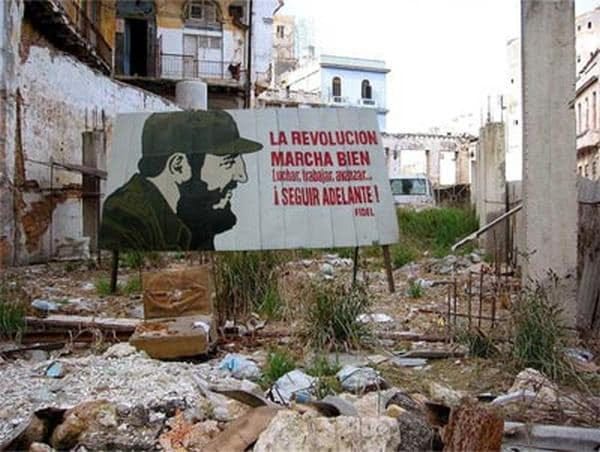
“The stench in 1945, all across Europe—including the town in which I was brought up, Portsmouth, where I could still see it when I was a small boy: the bomb sites, the rubble, the wreckage. But not all of it, because the stench of 1945, all the way across Europe, was the stench of disinfectant being sprayed on rubble. You can’t dig anymore—there’s no point in it. There’s only putrefaction and misery underneath you. You can’t keep digging if you don’t disinfect it. Now, I would say that the stench of disinfectant sprayed on rubble—the rubble on top of human remains—is the particular tang, stench, odor of fascism. And we used to, in our movement, in our pages and so on, say we’d give the title “anti-fascist” to the older comrades, to those who’d suffered and been through it and so on. We never thought, I think many of us, how soon we might have to earn it.”
—Christopher Hitchens, “Christopher Hitchens on Fascism”



That’s why I always called them a bundle of faggots!
Very thorough, thoughtful and in-depth! Thank you!