
Another lie is that if you have nothing to hide
One of the oldest lies ever told to human beings about privacy is that there is a divine dictatorship that knows your most intimate thoughts and even what you may do in your dreams. This superstitious shackle is responsible for endless shame and guilt over who people are and what they do, even in the privacy of their homes. Even the freedom to undress without being watched is something many people take for granted. When such supernatural surveillance is presented as benign, it becomes even more insidious because the condescending humiliation is justified as something “done for your own good.”
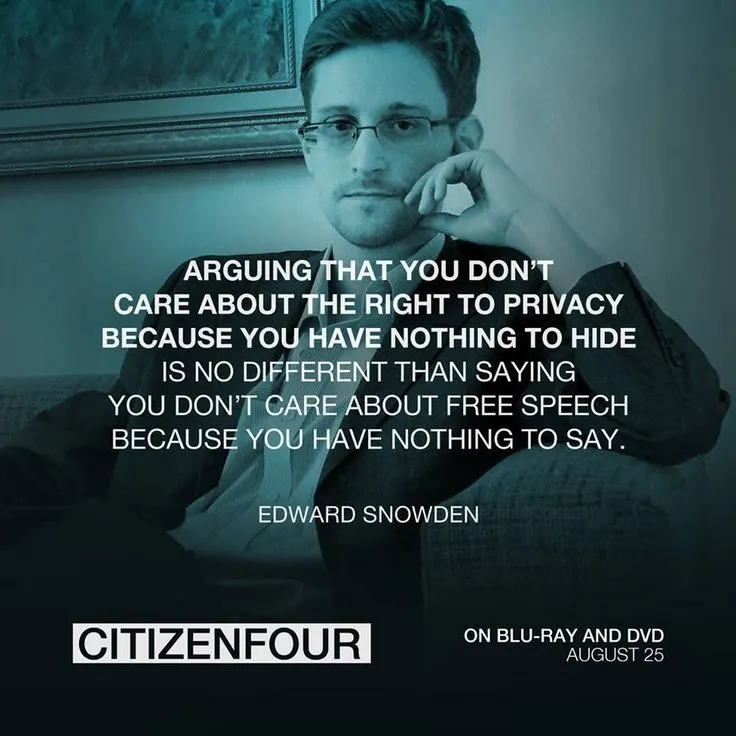
Another lie is that if you have nothing to hide, you have nothing to fear. Under tyranny, however, people must conceal activities that would be entirely lawful in a free society. You may not need to hide your favorite book now, but George Orwell’s 1984 was banned in the Soviet Union from its publication in 1949 until 1988, circulating through clandestine channels, often at considerable personal risk.
When a book is written about the importance of privacy, a regime intent on abolishing it will often prioritize banning it. It’s the same irony as burning Fahrenheit 451 to suppress literature—an irony history already delivered when its publisher, Ballantine, sold schools a censored edition of the novel for more than a decade.
The truth is that privacy is a fundamental human right that preserves our decency and dignity. It’s the freedom to make mistakes without having them broadcast to the world and the liberty to live authentically without constant judgment. We demand privacy not because we have something to hide, but because those who would deny us this right do have something to hide: their hatred of our freedom.
Given how essential privacy is, a government’s desire to abolish or undermine it can be understood as a totalitarian impulse. That impulse may manifest through mass surveillance, censorship, and the recruitment of citizens to spy on and report one another.
Whether the heavens are empty or God is more concerned with forgiveness than condemnation, privacy—at least within our minds—may remain possible.
What consenting adults do in private that does not involve harming others is not the business of the government. Our freedom of speech necessarily includes our freedom of thought, and we cannot be punished merely for patterns of electrical activity in our brains. When it comes to our own conscience, we are our own judge and jury.
That is why the most intimate form of privacy is intellectual sovereignty: control over one’s own beliefs and judgments. The independent mind therefore reserves the right to maintain jurisdiction over itself. No scholar or intellectual can demand, on the basis of allegedly superior knowledge, that we assent to any claim, however persuasive the argument may be. Human knowledge remains subject to error and revision, and experts are fallible human beings like everyone else. If we accept something as true, it should be because we have freely judged it to be supported by reason and evidence, not merely because authority or consensus commands our agreement. Freedom of belief also includes the freedom to be regarded as delusional by others. We reserve the right to disagree, even if you refuse to let us.
In the meantime, we’ll continue to watch the shows and movies we want, read the books we like, and express ourselves in ways that feel authentic rather than performative.
Digital Privacy
With the advent of the internet and digital life, greater emphasis has been placed on encryption and anonymity. Sufficiently weak encryption can be broken with enough time and processing power, while anonymity is often difficult to preserve even with a VPN. Users leave digital trails that law enforcement may trace by correlating timestamps, analyzing service logs, identifying technical data leaks, or matching online behavior and offline habits to a person’s real identity.
Two ways to reduce the risk of exposure are to encrypt sensitive data stored on internet-connected devices and to keep unencrypted sensitive data off those devices altogether. These precautions place some control back in the hands of individuals, but they cannot substitute for legal restraints on institutional surveillance.


Flock Cameras
Meanwhile, beyond the digital world, physical surveillance is becoming increasingly pervasive. Flock cameras, manufactured by Flock Safety, are automated license-plate readers (ALPRs) used by police departments, homeowners’ associations, and businesses. They capture license plates, vehicle make and color, time and location, and distinguishing details such as bumper stickers, converting that information into searchable data that may be shared among participating agencies.
These cameras have been promoted in the name of public safety, but as Benjamin Franklin said, “They who can give up essential liberty to obtain a little temporary safety deserve neither liberty nor safety.”
An ongoing review by the Institute for Justice has identified at least 24 cases nationwide in which police officers allegedly abused automated license-plate-reader systems, including Flock networks, to monitor current or former romantic partners and other romantic interests.

Chinese Surveillance
On an even larger scale, China is already far ahead of us. According to a 2023 report by Tech Wire Asia, China had more than 700 million surveillance cameras—approximately one for every two citizens. Such surveillance is intimidating because it reverses the proper democratic relationship: instead of government being accountable to its citizens, citizens are made to fear the government that is supposed to serve them.
Unchecked human surveillance cultivates paranoia and suspicion, driving people toward even deeper fear and distrust. If people need the threat of punishment or the promise of reward to behave well because they believe they are being monitored, often under the guise of benevolence, then the very idea of virtue is diminished, because moral conduct is compelled rather than freely chosen.
During the 2019 Hong Kong protests, demonstrators attempted to disable or destroy surveillance cameras, particularly those equipped with facial‑recognition capabilities. Protesters used spray paint, poles, and high‑powered laser pointers to obstruct or damage the cameras as part of an effort to resist police monitoring.
China operates a Social Credit System comprising government databases, court blacklists, and local pilot programs that track legal and regulatory compliance. Individuals placed on certain court‑issued blacklists can face penalties, including restrictions on high‑speed rail or air travel. This illustrates what unchecked surveillance powers could make possible here.

Privacy in the Law
In the modern era, the U.S. Supreme Court has repeatedly confronted constitutional questions involving privacy, personal liberty, and freedom from government intrusion:
- Griswold v. Connecticut (1965): The Court struck down a Connecticut law prohibiting married couples from using contraceptives. The majority recognized a constitutional right to marital privacy arising from the overlapping protections—or “penumbras”—of several guarantees in the Bill of Rights.
- Katz v. United States (1967): The Court held that the Fourth Amendment protects people rather than merely physical places. Justice John Marshall Harlan II’s concurrence articulated the “reasonable expectation of privacy” test that the Court later adopted for determining whether government surveillance constitutes a search.
- Eisenstadt v. Baird (1972): Applying the Equal Protection Clause, the Court invalidated a law that treated married and unmarried people differently in access to contraception. The opinion emphasized that the right of privacy belongs to the individual, whether married or single.
- Roe v. Wade (1973): The Court held that the constitutional right to privacy, founded principally in the Fourteenth Amendment’s protection of personal liberty, was broad enough to encompass a woman’s decision whether to terminate a pregnancy. Dobbs v. Jackson Women’s Health Organization overruled Roe and Planned Parenthood v. Casey in 2022, holding that the Constitution does not confer a right to abortion.
- Lawrence v. Texas (2003): Relying on the liberty protected by the Fourteenth Amendment’s Due Process Clause, the Court invalidated a Texas law criminalizing private, consensual sexual conduct between adults and overruled its earlier decision in Bowers v. Hardwick.
The Paradox of Privacy
If a government wishes to suppress civic activity, one effective way is to instill fear of privacy violations, leading people to sacrifice their voices merely to remain beneath the radar of surveillance. In the internet age, some avoid creating accounts or delete existing ones out of fear of scrutiny, retaliation, or professional consequences for expressing their views. In attempting to protect their privacy at all costs, they may ultimately surrender the very public voice and private life they hoped to preserve.
This paradox of privacy—how clinging to it too desperately can lead to losing it—is best expressed in the following passage:
“The mass man whom Himmler organized for the greatest mass crimes ever committed in history bore the features of the philistine rather than of the mob man, and was the bourgeois who in the midst of the ruins of his world worried about nothing so much as his private security, was ready to sacrifice everything – belief, honor, dignity – on the slightest provocation. Nothing proved easier to destroy than the privacy and private morality of people who thought of nothing but safeguarding their private lives. After a few years of power and systematic co-ordination, the Nazis could rightly announce: ‘The only person who is still a private individual in Germany is somebody who is asleep.’”
— Hannah Arendt, The Origins of Totalitarianism

Ultimately, privacy belongs to the individual: to the advocate, the voter, and the protester. It belongs to every person who chooses how to dress, behave, speak, and think without constant scrutiny.
We refuse to live under unchecked surveillance, whether imposed on Earth or imagined in Heaven. We will not be addressed as suspects, dismissed as irrational, or deprived of our rights merely because others fail to understand our need for dignity.
We have nothing to hide—we have something to protect.
Privacy is our right, and on this point, we are absolutely right.




Amen!